
Democracy is not collapsing everywhere, but it is unquestionably under strain. Across much of the world, governing democratic societies has become dramatically more difficult than it was for previous generations of leaders. Political polarization has intensified, trust in institutions has eroded, and movements skeptical of democratic norms are gaining influence in several countries that were once considered politically stable.
These developments are not confined to one nation or one political ideology. They represent a broader structural challenge confronting democratic governance in the twenty-first century.
For much of the late twentieth century, many scholars and policymakers believed democracy was on an unstoppable trajectory. The end of the Cold War created widespread optimism that democratic systems would continue to spread across the globe. The collapse of authoritarian regimes in Eastern Europe and the expansion of democratic institutions in Latin America and parts of Africa appeared to confirm this assumption.
But the past decade has complicated that narrative.
According to the Freedom House, global freedom has declined for more than fifteen consecutive years. Their annual reports show that democratic standards have weakened in dozens of countries during that period. The V‑Dem Institute has documented similar trends, identifying what researchers describe as “democratic backsliding” in a growing number of nations.
Even in long-established democracies, confidence in governing institutions has eroded. Surveys conducted by the Pew Research Center show that public trust in national governments has declined significantly across many advanced democracies over the past several decades. In the United States, trust in federal government institutions has fluctuated sharply since the 1970s and remains far below the levels recorded during the mid-twentieth century.
These patterns are not isolated statistical curiosities. They reflect deeper changes in the political environment in which modern democracies operate.
One of the defining features of this new environment is polarization. Political divisions that once existed primarily within legislative chambers have increasingly migrated into society itself. Citizens now consume political information through fragmented media ecosystems, often reinforcing ideological divisions rather than encouraging broad civic dialogue.
At the same time, technological change has transformed the pace of political life. Information now travels instantly, shaping public perception in real time. Political leaders must make decisions while navigating an environment where narratives can shift within minutes. This acceleration has fundamentally changed how governments communicate with citizens and how citizens evaluate political leadership.
Economic transformation has added another layer of pressure. Globalization and technological disruption have reshaped labor markets, economic opportunity, and social mobility in many societies. In numerous countries, voters now expect governments to address complex economic challenges while also preserving national identity, protecting domestic industries, and maintaining social cohesion.
These expectations often collide with the institutional realities of democratic governance.
Most democratic institutions were designed in earlier eras, when political communication was slower, economic systems were less globally integrated, and the pace of technological change was more gradual. As a result, many governments struggle to respond quickly to the demands of modern political life.
The tension between rising public expectations and institutional capacity has become one of the defining political challenges of our time.
Across Europe, nationalist parties skeptical of immigration and supranational governance have gained electoral support in several countries. In nations such as Hungary and Poland, political conflicts have emerged over judicial independence, media freedom, and the boundaries of institutional authority. These developments have sparked intense debate among scholars about the durability of democratic norms.
The United States has experienced its own form of democratic strain. American politics has become deeply polarized, and trust in institutions such as Congress, the media, and electoral systems has declined. Legislative gridlock has become increasingly common, and the presidency now operates within a political environment characterized by intense partisan conflict and constant public scrutiny.
Modern presidents face expectations that are often impossible to satisfy. Citizens demand decisive leadership and solutions to complex problems ranging from economic inequality to geopolitical competition. Yet the institutional tools available to presidents are constrained by divided legislatures, polarized electorates, and the broader dynamics of democratic politics.
This reality creates a fundamental paradox: presidents are expected to lead with authority while governing within systems that increasingly limit their ability to act decisively.
That paradox became the starting point for my research.
Over the past eighteen months, I set out to examine how leadership functions when democratic institutions themselves are under pressure. The result of that work is my book The Weight of the Biden Presidency: Power, Repair, and the Strain of Governance.
The book examines the modern American presidency as a case study in democratic strain. It explores how presidents attempt to govern while navigating institutional constraints, political polarization, and the complex expectations of modern democratic societies.
Rather than offering partisan commentary, the book seeks to understand how executive leadership operates when the political system itself is under stress. The presidency sits at the center of American political life, but it also reflects the broader institutional pressures shaping governance in democratic systems.
My interest in these issues did not develop solely through academic research. Much of my professional life has involved observing how governments function under real-world conditions.
I served twenty years in the United States military. During that time I observed firsthand how governments exercise power and how military institutions interact with political leadership in shaping foreign policy and national strategy. Military service also provided an international perspective on the ways different societies organize authority and respond to political challenges.
Beyond military service, my career has included work in public policy, social services, and veterans advocacy. I served as the executive director of a national organization focused on empowering military veterans and worked in policy environments related to correctional services and community programs. These experiences provided insight into how government policies affect the lives of working-class citizens and vulnerable communities.
Over the course of my career I have also worked across four continents. Those experiences reinforced an important lesson: governance cannot be understood solely through domestic politics. Political institutions are shaped by global economic forces, technological change, and geopolitical competition.
One of the most significant developments of the past several decades has been the evolving balance of global power. While the United States remains one of the world’s most influential nations, the international system is increasingly shaped by the rise of new economic actors. China’s expanding economic presence across Africa and other regions illustrates how global influence is shifting in ways that will shape international politics for decades to come.
These observations have influenced the broader scope of my writing. My first book, Faux News: Mau-mauing in the Era of Trump and Biden, examined how political rhetoric and media narratives influence public understanding of politics and governance.
My forthcoming book on China–Africa relations from 1990 to 2025 explores how economic engagement between China and the African continent is reshaping global trade and development patterns.
I am also working on a book examining the trajectory of American democracy as the United States approaches the 250th anniversary of its founding. That project explores how democratic institutions have evolved over nearly two and a half centuries and how they are adapting to the pressures of the modern political era.
Taken together, these projects reflect a broader intellectual interest in the changing nature of governance in the twenty-first century.
Democracies today face multiple intersecting pressures: political polarization, technological disruption, economic transformation, geopolitical competition, and declining institutional trust. None of these forces operates independently. They interact in ways that shape how governments function and how citizens perceive political authority.
Understanding these dynamics is essential for anyone concerned about the future of democratic institutions.
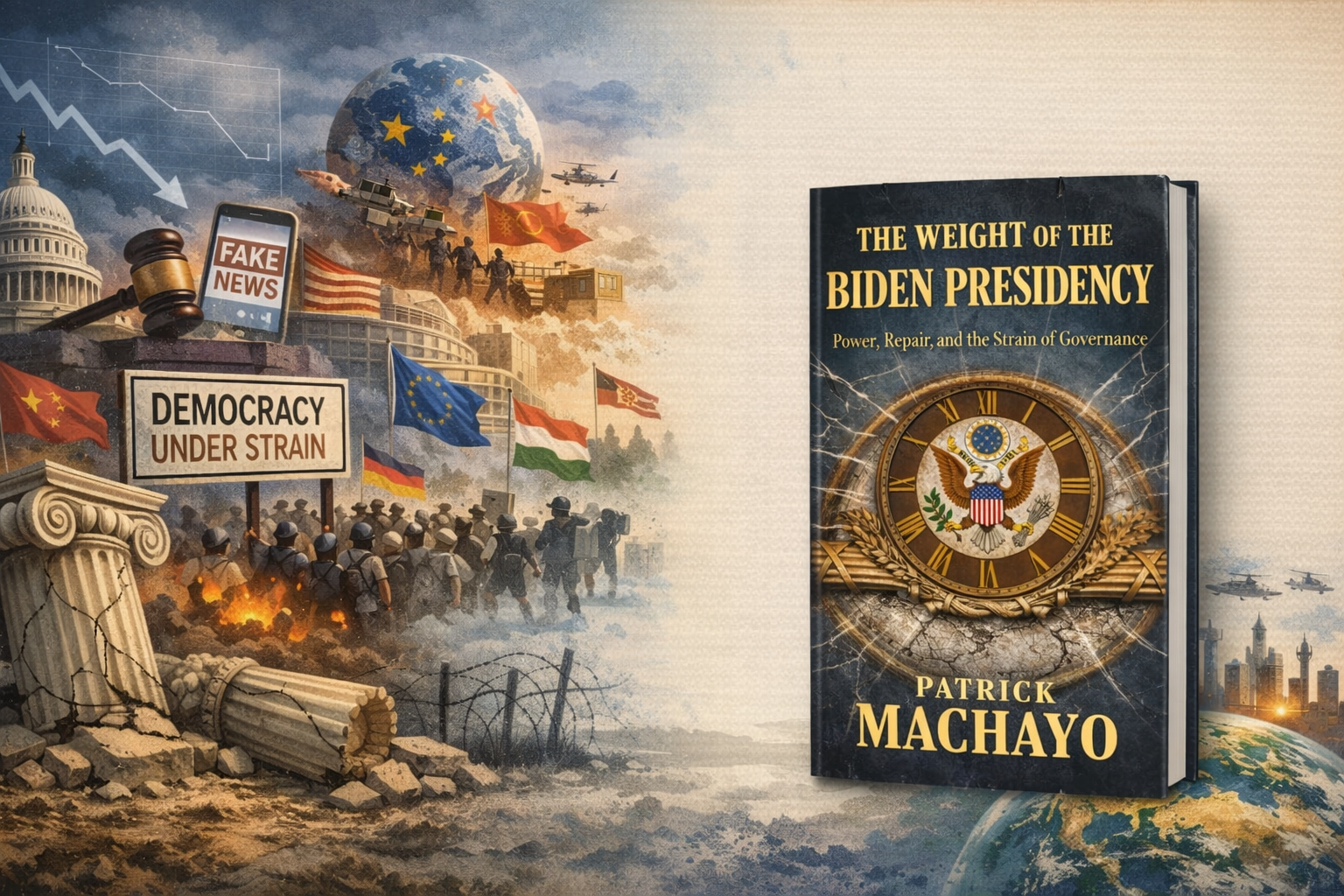
The Weight of the Biden Presidency examines one part of this larger story. By analyzing the pressures facing modern presidential leadership, the book seeks to illuminate the broader challenges confronting democratic governance in the twenty-first century.
The issues explored in the book extend far beyond any single political administration or party. They reflect structural pressures affecting democratic systems around the world.
Democracy has endured many periods of tension and transformation throughout history. The question facing the twenty-first century is whether democratic institutions can adapt once again to the pressures of a rapidly changing world.
My hope is that this book contributes to that conversation.
The Weight of the Biden Presidency: Power, Repair, and the Strain of Governance will be released in the coming days.